What to say when emailing a resume — 6 methods you can try now
- Alex Khamis

- Aug 5, 2025
- 14 min read
Updated: Aug 6, 2025
Sending your resume is more than just an attachment; it's an important first impression. The body of your email is your first opportunity to engage a hiring manager, recruiter, or networking contact.
A generic, poorly written message can send your carefully written resume straight to the proverbial trash bin.
Conversely, a concise and compelling email can quickly position you as a high-value candidate worthy of consideration. Understanding exactly what to say when emailing your resume is the key that unlocks the door to a conversation.
This guide moves beyond generic templates. We'll dissect six distinct, actionable methods for writing emails that command attention and drive responses.
You will learn not just what to write, but why it works, with detailed breakdowns for various scenarios, from cold outreach to warm referrals.
For those sending unsolicited applications, mastering the initial message is very important. For a more complete guide on writing compelling initial outreach, explore this resource on how to write cold emails that get replies. Each example in this article is designed to provide you with a replicable framework to showcase your value, articulate your fit, and secure that crucial next step: the interview.
1. The Direct and Concise Approach
When you need to send your resume for a clearly defined role, especially when applying through a company's designated careers email or an Applicant Tracking System (ATS), the 'Direct and Concise Approach' is your best bet.
This method prioritizes clarity by eliminating fluff to make sure your application is processed fast. It respects the recruiter’s time by getting straight to the point.
The core principle is simple: state your purpose, identify the specific role you are applying for, and direct the reader to your attached documents.
This isn’t the place for a lengthy narrative or a detailed pitch; your resume and cover letter will handle that. The email's only job is to be the professional, streamlined delivery vehicle for your application.
Example
Let’s analyze a classic example of what to say when emailing your resume using this direct method.
Subject: Application: Senior Project Manager (Job ID 78910)
Body: Dear [Hiring Manager Name] or Hiring Team,
I'd like to express my interest in the Senior Project Manager position, which I found advertised on LinkedIn.
My resume is attached for your review. It details my 12 years of experience leading cross-functional project teams and managing complex project lifecycles in the IT sector.
Thanks for your time and consideration.
Best regards,
[Your Name]
[Your Phone Number]
[Link to your LinkedIn Profile]
Breaking it down
Subject Line — The subject is a model of efficiency. It includes the word "Application," the exact job title, and the Job ID. This is important for internal routing and helps recruiters immediately categorize your email.
Clear Purpose — The first sentence states the intent and the source of the job posting (LinkedIn). This provides immediate context.
Brief Value Statement — While direct, the email includes one powerful sentence that bridges your experience to the role's requirements. This adds a touch of personalization without bloating the email.
Call to Action — The email clearly directs the recipient to the attached resume, which is the primary goal of the communication.
To help you master this technique, the summary box below outlines the essential components.

These three elements form the backbone of a successful direct application email, ensuring your message is professional and effective.
Overcomplicating this step is a common error; you can learn more about avoiding critical job search mistakes that might be costing you opportunities. The goal is to move the process forward, not to tell your entire career story in the email body.
2. The Value Proposition Method
When you have a highly relevant, quantifiable achievement that perfectly aligns with a company's needs, the 'Value Proposition Method' is your play.
This method front-loads your email with your single most impressive accomplishment, immediately showing your potential impact. Popularized by career coaches and executive recruiters, it transforms your email from a simple application into a compelling, data-backed pitch.

The core principle is to lead with undeniable proof of your value. Instead of just stating your interest, you are showing the hiring manager exactly what kind of results they can expect by hiring you.
This method is particularly effective for sales, marketing, and leadership roles where metrics are king, or for anyone whose resume contains a "wow" factor that deserves to be highlighted upfront.
Example
Let’s analyze a potent example of what to say when emailing your resume using the Value Proposition Method.
Subject: Experienced Sales Manager - 150% Revenue Growth
Body: Dear Ms. Johnson,
I increased regional sales by 150% over two years at ABC Corp, and I'm excited to bring this track record of growth to the Sales Manager position at XYZ Company.
My attached resume details how my expertise in team building and market penetration strategies can contribute directly to your expansion goals.
I look forward to discussing this opportunity further.
Best regards,
[Your Name]
[Your Phone Number]
[Link to your LinkedIn Profile]
Breaking it down
Subject Line — The subject line itself is a value proposition. It grabs attention by combining the target role with a powerful, quantifiable result (150% Revenue Growth), making it impossible for a busy recruiter to ignore.
Lead with Impact — The very first sentence is a powerful, one-sentence summary of your biggest win. It immediately answers the hiring manager's core question: "Why should I care about this applicant?"
Connect Value to Needs — The email explicitly connects the past achievement to the future role and the company's specific goals (expansion). This shows you've done your research and are a strategic thinker.
Resume as Proof — The email positions the attached resume as the source of further evidence, encouraging the reader to open it to understand how you achieved such impressive results.
This technique is especially powerful for professionals making a career change, as it allows you to lead with a transferable skill or achievement. You can find more strategies for this in our guide on how to write a career change cover letter. This approach ensures your email doesn’t just ask for a job; it demonstrates your immediate worth.
3. The Referral-Based Introduction
When a mutual connection recommends you for a role, the 'Referral-Based Introduction' is the gold standard for what to say when emailing your resume.
This approach sets you apart from the pack by using a trusted internal source. It shifts the dynamic from an unknown candidate to a recommended one, instantly building credibility.
The strategy is to place the referral's name front and center, both in the subject line and the opening sentence.
This creates an immediate, warm connection and signals that your application warrants special consideration. It’s an endorsement that bypasses the formal application pile and puts your resume directly into the hands of the decision-maker.
Example
Let’s look at how to frame an email when you have an internal referral.
Subject: Referred by John Smith for Project Manager Role
Body: Dear Ms. Davis,
John Smith, your current Development Director, suggested I reach out directly regarding the Project Manager opening on your team. We worked together at our previous company, and he felt my background in agile methodology and successful project delivery would be particularly valuable to your current initiatives.
My resume, which I have attached for your review, provides further detail on my qualifications and achievements.
Thank you for your time and consideration. I look forward to hearing from you soon.
Best regards,
[Your Name]
[Your Phone Number]
[Link to your LinkedIn Profile]
Breaking it down
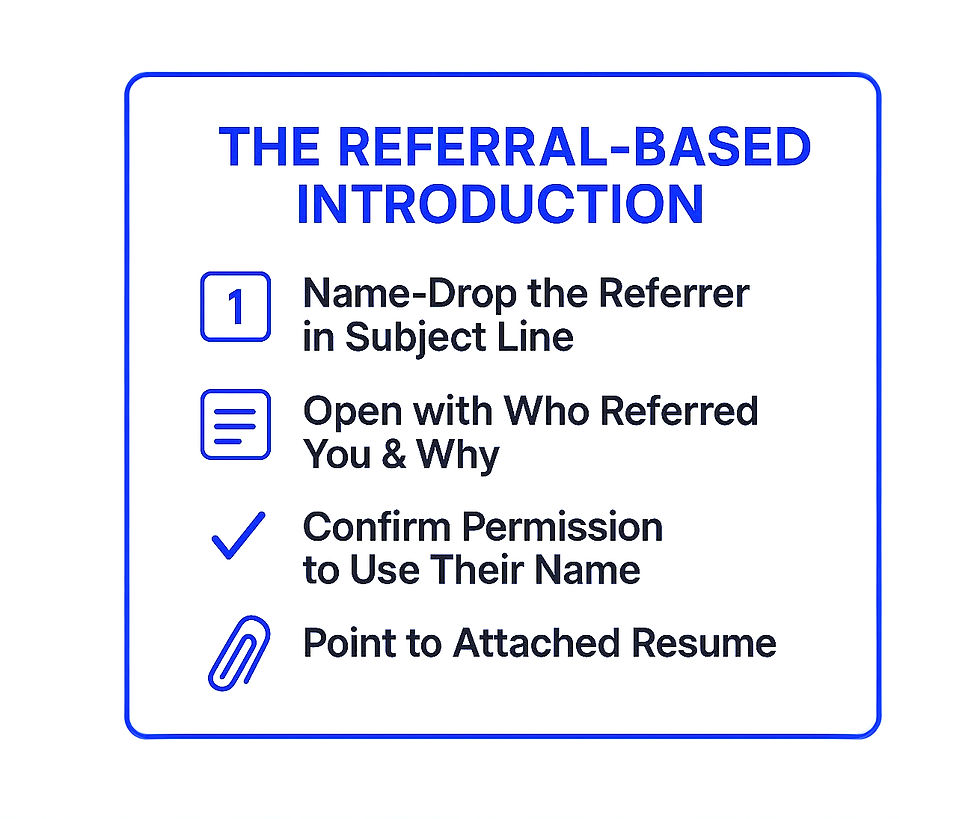
Subject Line — The subject line is direct and impactful. It immediately name-drops the referrer ("John Smith"), ensuring the email gets opened and prioritized over generic applications.
Contextual Opening — The first sentence wastes no time. It explains who referred you and why, providing immediate context and legitimacy. Mentioning how the referrer thought your specific skills (agile methodology) align with the team's needs adds a layer of targeted value.
Professional Courtesy — Always secure permission from your contact before using their name in an application. This is a crucial step that maintains your professional integrity and ensures your referrer is prepared to speak on your behalf if contacted.
Clear Call to Action — The email smoothly transitions from the referral to the next step: reviewing the attached resume. This keeps the message focused and action-oriented.
By using a referral, you are not just sending a resume; you are delivering a vetted recommendation.
Your LinkedIn profile should be polished and ready for review, as it's often the first place a hiring manager will look after reading your email.
You can find essential tips on how to optimize your LinkedIn profile to reinforce the strong impression made by your referral. This approach significantly increases your chances of securing an interview.
4. The Research-Driven Approach
When you want to show real interest and move beyond a generic application, the 'Research-Driven Approach' is your most powerful strategy.
This method involves referencing specific company news, achievements, or initiatives to show you’ve done your homework. It immediately separates you from candidates sending mass emails, proving you are proactively invested in this specific opportunity.
The goal is to connect your skills and enthusiasm directly to the company's current trajectory. By mentioning a recent project, a new market expansion, or even a value highlighted in their latest annual report, you create an instant, relevant connection.
This shows you're not just looking for any job; you're targeting a role at their organization for a specific reason.

Example
Let’s examine how to effectively use research when deciding what to say when emailing your resume.
Subject: Application for Digital Marketing Specialist Position
Body: Dear [Hiring Manager Name] or Hiring Team,
I am writing to apply for the Digital Marketing Specialist role I saw advertised on your careers page. I was particularly impressed by TechCorp's recent expansion into the European market and your team's innovative "Future Forward" campaign.
As a digital marketer with five years of experience in international campaign management and a proven track record of growing audience engagement by over 30%, I am excited by the opportunity to contribute to your continued global growth. My resume is attached for your review.
Thank you for your consideration.
Best regards,
[Your Name]
[Your Phone Number]
[Link to your LinkedIn Profile]
Breaking it down
Subject Line — The subject is professional and clear. While not as detailed as an ATS-focused subject, it states the purpose and position, ensuring it's routed correctly.
Informed Opening — The first paragraph immediately mentions a specific company achievement (European expansion) and a named campaign ("Future Forward"). This proves you've done more than just read the job description.
Strategic Skill Connection — The next sentence doesn't just list skills; it directly connects the applicant's "international campaign management" experience to the company's "global growth." This bridge is what makes the research effective.
Call to Action — It concludes with a clear directive to the attached resume, maintaining the email's primary function as a delivery mechanism.
This approach turns your application from a simple submission into a thoughtful conversation starter. The effort to find and include these details is minimal, but the impact is huge.
Similar research and customization are very important for application materials beyond the email; you can learn more about how to tailor your resume to the job posting to ensure your entire package is cohesive. This method shows a level of professional maturity and strategic thinking that recruiters value highly.
5. The Problem-Solution Format
When your goal is to stand out from a crowd of qualified applicants, the 'Problem-Solution Format' is a great tactic to put to use.
Instead of stating your interest, this approach positions you as a strategic thinker who understands the company's challenges.
It requires research and a deep understanding of the industry, but it immediately illustrates your value.
It moves beyond the basic job description to address a specific pain point or opportunity you've identified within the company or its market.
By framing your experience as the direct solution to that problem, you shift the conversation from what you've done to what you can do for them. This is particularly effective for management, consulting, and technology roles where proactive problem-solving is a core competency.

Example
Let’s look at what to say when emailing your resume using the Problem-Solution Format to showcase your strategic value.
Subject: Addressing Remote Work Vulnerabilities - Cybersecurity Analyst Application
Body: Dear [Hiring Manager Name] or Security Team Lead,
As remote work continues to expand, I understand that protecting distributed teams and sensitive data is a critical priority for companies in the fintech sector. The rise in sophisticated phishing attacks presents a significant challenge.
My resume, attached for your review, details how I recently implemented a zero-trust security framework that reduced breach attempts by 60% at my previous company. I am confident I can bring a similar proactive approach to strengthening your security posture.
I would welcome the opportunity to discuss this further.
Best regards,
[Your Name]
[Your Phone Number]
[Link to your LinkedIn Profile]
Breaking it down
Subject Line — The subject line is compelling and benefit-oriented. It immediately identifies a key industry problem ("Remote Work Vulnerabilities") before mentioning the role, grabbing the hiring manager's attention by speaking to their concerns.
Identified Pain Point — The opening sentence shows you've done your homework. It pinpoints a specific, relevant industry challenge (cyber threats for remote teams in fintech), demonstrating commercial awareness.
Quantifiable Solution — The email doesn't just list skills; it provides a direct, data-supported solution. The "reduced breach attempts by 60%" statistic is a powerful proof point that makes your value tangible and impressive.
Clear Next Step — The call to action is confident and forward-looking, inviting a discussion about the solution rather than just a review of your past.
This approach transforms your application from a simple request into a compelling business case. You can find more helpful advice for your job search in these resources for job seekers from Final Draft Resumes. The key is to connect your accomplishments directly to the employer's needs, proving you are the solution they have been looking for.
6. The Personal Story Method
When your goal is to create an immediate, human connection that goes beyond a standard application, the 'Personal Story Method' is a great choice.
This technique uses a brief, relevant personal anecdote or a key career moment that ties directly to the role or the company’s mission. It’s particularly effective in creative industries, education, nonprofits, and mission-driven startups where passion and cultural fit are highly valued.
The principle is to humanize your application by sharing a glimpse of your "why." Instead of just stating your qualifications, you’re showing the motivation behind them.
It transforms your email from a transactional document delivery into a memorable introduction, making the hiring manager feel a personal connection to your candidacy before they even open your resume.

Example
Let's break down an effective example of what to say when emailing your resume using a personal story to make an impact.
Subject: Application for 3rd Grade Teacher - Inspired by Your STEM for Kids Initiative
Body: Dear Principal Martinez,
When my eight-year-old daughter built her first robot at a workshop sponsored by your school, I saw firsthand the impact of your STEM for Kids initiative. That experience solidified my desire to be part of a team that creates those powerful "aha" moments for young learners.
As a certified elementary teacher with six years of experience in project-based learning, I am thrilled to apply for the 3rd Grade Teacher position I saw advertised on the district website. My resume, attached for your review, details my background in developing hands-on science and math curricula.
Thank you for your time and for building such an inspiring program in our community.
Warm regards,
[Your Name]
[Your Phone Number]
[Link to your LinkedIn Profile]
Breaking it down
Subject Line — The subject immediately establishes a personal connection ("Inspired by...") and signals a genuine interest beyond a generic application. It’s unique and likely to stand out in a crowded inbox.
Opening Hook — The email opens with a compelling, authentic story. It connects the applicant directly to the school's specific work, demonstrating deep research and personal investment.
Seamless Transition to Skills — The story isn't just for emotional impact; it serves as a perfect bridge to the applicant's professional qualifications. The transition from the personal anecdote to their teaching experience feels natural and reinforces their suitability for the role.
Professional Closing — While personal, the tone remains professional. The closing line reiterates appreciation for the company's specific work, ending on a high note of respect and shared values.
This approach is about creating a narrative that makes your application unforgettable. When deciding what to say when emailing your resume, using a brief, relevant story can be the differentiator that gets you noticed.
The key is to ensure the story is concise, directly relevant, and reinforces why you are the ideal candidate for that specific role and organization.
Final Thoughts
Figuring out what to say when emailing your resume is less about finding a single "perfect" template and more about developing strategic communication skills.
Throughout this guide, I've deconstructed six approaches, from the direct and concise to the research-driven and personal story methods. Each one serves a different purpose, tailored to a unique professional context.
The core lesson is that your email isn't just a delivery mechanism for your resume; it is the first real test of the way you communicate and the way you think.
Key Takeaways
To improve your outreach activities, distill the strategies I've covered into a repeatable process. The most successful people don't just send emails; they execute a communication strategy.
Context is King — The most important takeaway is that your method must match the situation. A cold email to a CEO demands a different tone and structure than a follow-up with a recruiter who requested your resume. Always ask: who is my audience, and what is my goal?
Value Before Volume — The Value Proposition and Problem-Solution methods underscore a vital principle: lead with what you can do for them, not what you want from them. Frame your skills as solutions to their specific challenges. This shifts the dynamic from applicant to potential partner.
The Power of Connection — Whether leveraging a referral or telling a personal story, the goal is to create a human connection. Hiring managers and executives receive hundreds of generic emails. Yours will stand out if it establishes genuine, memorable common ground.
Subject Lines are Your First Impression — Never treat the subject line as an afterthought. It is the gatekeeper to your message. As demonstrated, a well-crafted subject line is specific, professional, and compelling enough to guarantee an open.
Recapping All Six Email Methods
Your Next Steps
Moving forward, your goal is to transition from simply knowing what to say when emailing your resume to internalizing these strategic frameworks. Start by identifying your top three target companies and the key decision-makers within them.
Next, choose one of the methods we've detailed that best aligns with your next career move. Draft an email using that structure, focusing intently on tailoring the value proposition and personalizing the content based on your research.
This deliberate practice will transform these concepts from abstract ideas into a powerful part of your job-seeking toolkit. Ultimately, the goal is to make a powerful, positive, and lasting impression that positions you not just as a candidate, but as the inevitable choice.
Frequently Asked Questions
General Questions
How long should a resume be?
Keep it between 75-150 words. Your email should be long enough to provide context and show value, but short enough that busy hiring managers will actually read it. The email isn't your sales pitch—that's what your resume and cover letter are for.
Should I attach both my resume and cover letter to the email?
Yes, when possible. Attach your resume as a PDF and include a tailored cover letter unless the job posting specifically says not to. Name your files professionally: "FirstName_LastName_Resume.pdf" and "FirstName_LastName_CoverLetter.pdf."
What's the best time to send my resume via email?
Tuesday through Thursday, between 8 AM and 11 AM in the company's time zone typically sees the highest open rates. Avoid Monday mornings (inbox overload) and Friday afternoons (weekend mindset).
Subject Line Questions
What if I don't have a job ID number for the subject line?
Use the exact job title as posted, plus your name or a key qualification. For example: "Application: Marketing Manager - John Smith" or "Senior Developer Application - 8 Years React Experience."
Should I use "RE:" in my subject line?
Only if you're responding to a specific request or continuing an existing email thread. For initial applications, start fresh with a clear, direct subject line.
Can I use creative subject lines to stand out?
Stick to professional, clear subject lines for most industries. Creative fields like advertising or marketing might allow more personality, but when in doubt, choose clarity over creativity.
Content and Approach Questions
Which email method should I use if I'm changing careers?
The Value Proposition Method works best for career changers. Lead with a transferable skill or achievement that directly applies to your new field. This helps hiring managers see past your different background to your relevant value.
What if I don't have any connections at the company for a referral?
Use LinkedIn to find mutual connections, alumni from your school, or people in similar roles. You can also try the Research-Driven Approach by mentioning specific company news or initiatives to show genuine interest.
How much company research should I include in my email?
One specific, recent detail is enough. Mention a new product launch, recent expansion, or company value that connects to your experience. Don't overdo it—you want to sound informed, not obsessive.
Should I mention salary expectations in my initial email?
No. Save salary discussions for later in the process. Your initial email should focus on demonstrating value and securing an interview.
Author

Alex Khamis is a Certified Professional Resume Writer and Managing Partner at Final Draft Resumes and Resumatic.
He has over six years of experience helping job seekers create compelling career narratives on top of 12 years of business and technical communications experience in the engineering industry.


Comments