How to Network Effectively: A No-Nonsense Guide to Building Real Connections
- Alex Khamis
- Dec 11, 2025
- 13 min read
Let's be blunt. To network effectively, you have to stop collecting contacts and start building genuine relationships. It's a long game where a few strong connections are worth more than a hundred weak ones.
Why Your Networking Efforts Are Failing

Most networking advice is garbage. It tells you to hoard business cards, blast out generic LinkedIn requests, and ask for favors from strangers. This approach feels fake because it is fake.
All you're left with is a bloated contact list. It's full of people who don’t know, trust, or care about you. It’s the professional equivalent of hoarding, and it almost never works.
As a hiring manager, this kind of networking is easy to spot. It's transparently self-serving and the number one reason the whole process feels exhausting and pointless to so many people.
The Myth of "More is Better"
The idea that a massive network is the key to success is a myth. A huge list of connections is useless if nobody on it will take your call. What you really need are allies, not just names in a spreadsheet.
This quantity-over-quality mindset is a fast track to burnout. It makes networking feel like a numbers game. In reality, it's about strategic relationship building.
The goal isn't to be the most connected person in the room. The goal is to be the most trusted, respected, and helpful person in your professional circle.
Think of it like this: a bridge is strong because a few key stones are locked together, not because of how many pebbles are in its foundation. Your network is built the same way.
The data backs this up. While a larger network can mean a slightly higher salary, the real story is that less than 20% of LinkedIn connections provide substantial value. Quality is what actually moves the needle.
Outdated Tactics vs. Modern Strategies
To get this right, you have to ditch the old-school habits. The difference between success and spinning your wheels is your game plan. A bad strategy is why you might be wondering why you're not getting job interviews.
Here’s what to drop and what to adopt.
Outdated Tactic | Modern Strategy | Why It Works Better |
|---|---|---|
Collecting business cards | Having meaningful conversations | Focuses on rapport, not just contact info. |
Asking "What can you do for me?" | Offering "How can I help you?" | Establishes you as a giver and builds trust. |
Generic LinkedIn requests | Personalized connection messages | Shows you’ve done your research and respect their time. |
Pitching yourself immediately | Asking insightful questions | Builds a real connection based on curiosity. |
Making this shift changes everything. Networking stops being a chore. It becomes a natural part of being a curious and generous professional.
Laying the Groundwork for Powerful Connections

Showing up to an event or firing up LinkedIn without a plan is a colossal waste of time. The most powerful networking happens long before you shake a hand or send a request. It’s about being strategic.
Randomly attending industry mixers and hoping for a lucky break is a losing game. You just end up with a pocket full of business cards from people in totally unrelated roles. Be ruthlessly selective.
Instead of just showing up, you need a pre-game strategy. This means figuring out the right people and the right places that actually move you closer to your goals.
Define Your Networking Goals
First, what are you actually trying to accomplish? "Meeting new people" isn't a goal; it's a vague wish. Get specific. Clear goals dictate your actions and prevent you from spinning your wheels.
What does a successful outcome look like for you right now? Be brutally honest. Maybe it's learning about a new industry, finding a mentor, or getting an introduction at a target company.
A common mistake is treating every networking opportunity the same. You wouldn't use a hammer to saw a board, right? Your goal for a huge conference should be different from a one-on-one coffee chat.
Here are a few practical, non-fluffy goals:
Learning Goal: Learn one new industry trend from an expert. For example, "I want to understand how AI is impacting supply chain logistics from someone at the event."
Connection Goal: Identify one person who could be a potential mentor. For instance, "I will have a substantive conversation with a Director of Marketing."
Opportunity Goal: Secure one informational interview at a target company within two weeks.
Setting specific goals transforms networking from a social chore into a targeted mission. It also gives you a real way to measure if your efforts are paying off. For more on this, check out these proven tips for networking effectively.
Research Before You Reach Out
Once you know what you want, zero in on the right people. But don't just find names—do your homework. This is the single step that separates amateurs from pros.
Researching someone isn't about being creepy; it’s about respecting their time. It shows you're serious. Your first stop is their LinkedIn profile. Of course, this means your own profile must be sharp. Our guide can help you optimize your LinkedIn profile.
Look for common ground and conversation starters. A little digging goes a long way.
Did they write an article? Actually read it.
Were they on a podcast? Listen to what they said.
Do you share a mutual connection? Make a note of it.
Has their company been in the news? Be aware of it.
This information is gold. It lets you skip the boring small talk ("So, what do you do?") and dive straight into a meaningful conversation.
Craft Your 30-Second Introduction
Let's kill the "elevator pitch." It sounds rehearsed and salesy. Nobody wants to hear a corporate monologue at a cocktail hour.
What you need is a clear, concise way to explain who you are, what you do, and why someone should care, all in under 30 seconds. Think of it as your professional headline.
Here’s a simple formula that actually works:
Who You Are: "I'm a senior project manager..."
What You Do (Problem You Solve): "...who specializes in turning around at-risk tech projects."
A Point of Interest/Curiosity: "...right now, I'm digging into how AI is changing project workflows."
This isn't a script you memorize. It's a framework for a natural introduction. It’s confident, it’s clear, and it opens the door for a real conversation by ending with a hook.
How to Navigate Conversations with Confidence
This is where the real work begins—the moment you open your mouth. Let's get tactical about how to work a room, whether it’s a packed conference hall or a Zoom breakout session.
Many professionals dread this part. They stress about what to say and how to exit without feeling awkward. But navigating conversations is a skill, not an innate talent. It can be learned and practiced.
The key is to flip your mindset from "What can I get?" to "What can I learn?" This simple change is transformative. It turns you from a self-serving salesperson into someone genuinely curious and engaging.
Making a Graceful Entrance
Walking into a room full of strangers feels like the first day of high school. The easiest way to join a conversation is to find a group that looks open and approachable.
Look for groups of three or five where people have left a small gap in their circle. It’s often an unspoken invitation. Avoid interrupting two people locked in an intense one-on-one discussion.
Once you’re nearby, just listen for a moment. When you find a natural pause, slide in with a simple, "Mind if I join you? I'm [Your Name]." It’s polite, non-disruptive, and it works.
Ditching the Dreaded "What Do You Do?"
It's the most common conversation starter, and also the absolute worst. "So, what do you do?" immediately puts people on the defensive and frames the interaction around job titles. It’s lazy and uninspired.
Your goal is to ask insightful questions that build real rapport. Think less like an interrogator and more like a podcast host. You want to uncover a story, not just a job description.
Instead of the tired classic, try one of these:
"What's the most interesting project you're working on right now?"
"What brought you to this event today?"
"I saw you spoke on [topic]—what's one thing you hope people took away?"
"What’s a big challenge your industry is facing that most people don't know about?"
These questions open the door to far more interesting discussions. They show you're curious about their work, not just their rank. You can dive deeper into these skills in our guide on how to improve communication skills.
The Power of Active Listening
Let's be blunt: most people don't really listen. They just wait for their turn to talk. Active listening means actually hearing and processing what the other person is saying. It’s about being present.
When someone is speaking, give them your full attention. Make eye contact. Nod. Ask clarifying questions like, "When you say you 'streamlined the process,' what did that look like?" This proves you’re engaged.
A huge networking mistake is dominating the conversation. The most memorable networkers are often the best listeners. They make you feel like you're the most important person in the room.
Face-to-face engagement is still king. Nearly 100% of professionals believe in-person meetings build stronger relationships. Those non-verbal cues are powerful. You can discover more insights about networking trends at apollotechnical.com.
Making a Memorable Exit
Knowing how to leave a conversation is just as important as starting one. Sticking around too long can make things awkward and prevents you both from meeting other people.
Watch for cues that a conversation is winding down. Are they looking around the room? Is there a lull in the dialogue? These are your signals to move on. Don't just ghost them.
Here’s a simple, four-step script that works:
Acknowledge: "I've really enjoyed our chat about [specific topic]."
State your intention: "I know we both want to meet other people, so I'm going to let you go."
Propose the next step: "I'd love to connect on LinkedIn to continue this conversation."
End with a handshake: "It was a pleasure meeting you, [Name]."
This process is polite, professional, and leaves the door open for future interaction. It shows social awareness and respect for their time—qualities that make you stand out.

Mastering the Follow-Up That Secures Relationships
The most important part of networking happens after the conversation. It's also where at least 90% of people completely drop the ball, letting a promising connection die.
A generic, copy-paste message is worse than sending nothing. It screams, "You are now on my spam list." Your goal here is to build a real relationship, not just collect another contact.
This whole process—from walking up to someone to saying goodbye—is designed to make this follow-up feel natural.
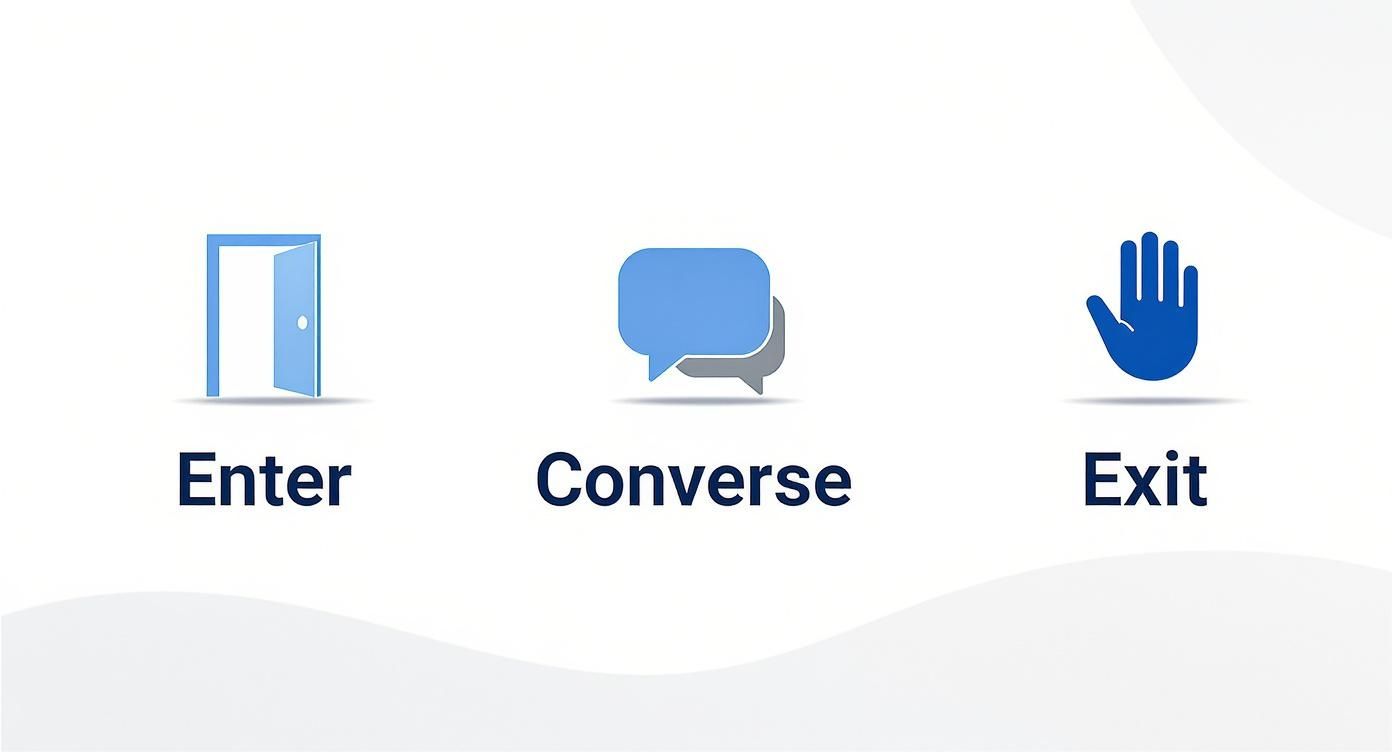
When you get the entry, conversation, and exit right, the follow-up becomes the obvious next step.
The 24-Hour Rule and What to Write
Timing is everything. Send your follow-up message within 24 hours. Wait any longer, and the specifics of your chat will fade from their memory. Your impact will vanish with it.
Your message, whether on LinkedIn or email, must be personal. A strong follow-up accomplishes three things, and it does them quickly.
Jog their memory: Briefly mention where you met. "Hi Jane, great meeting you at the Tech Innovators conference yesterday by the coffee station."
Reference a specific detail: This part is non-negotiable. It proves you were listening. "I really enjoyed our discussion about the challenges of implementing AI in legacy systems."
Add value immediately: This is where the magic happens. Don't ask for a thing. Instead, offer something helpful.
The cardinal sin of the follow-up is asking for a favor right away. "Can you look at my resume?" or "Do you have any job openings?" are immediate deal-breakers. You haven't earned that yet. Give first.
How to Add Value Without Being Obvious
Adding value is simpler than it sounds. It’s about being thoughtful and showing you understand their world. A well-timed message reinforces the connection. You can get great ideas on how to send effective meeting follow-up emails.
Here are a few practical ways to offer value:
Share a relevant article: "Following our chat, I thought you might find this article on Asana vs. Trello interesting."
Suggest a helpful tool: "You mentioned looking for better marketing automation. I’ve had great success with a tool called MailerLite."
Make a useful introduction: "I recall you were looking for a graphic designer. A talented colleague of mine does fantastic work, and I'd be happy to introduce you."
This approach instantly reframes you from a "taker" to a "giver." It shows you're a valuable part of the network, not just someone looking for a handout. This is how you earn the right to later figure out how to ask for recommendations on LinkedIn without being awkward.
Building Your Network in a Digital World
Modern networking is a hybrid game. If you're ignoring the digital side, you're leaving huge opportunities on the table. But just having a LinkedIn profile isn't a strategy—it's the bare minimum.
Too many people treat LinkedIn like a dusty trophy case, only updating it when they’re job hunting. That's a massive mistake. Your online presence should be a living extension of your professional identity.
The goal is an integrated approach. Your online activity should feed your in-person efforts and vice versa. This creates a powerful feedback loop that multiplies your reach and impact.
Stop Being a Digital Ghost
Just being on LinkedIn isn't enough. You have to participate. A passive profile is an invisible one. The simplest way to build visibility is to engage with other people's content.
And no, I don't mean dropping a generic "Great post!" on everything. That’s the digital equivalent of a limp handshake. Meaningful engagement takes a bit of thought.
Here’s how to do it right:
Add to the conversation. Instead of a thumbs-up, leave a comment that offers a new perspective. "Great point on AI in marketing. Have you seen how it's also impacting customer service workflows?"
Share with context. When you share an article, add your own two cents. A quick sentence on why it’s important positions you as a thoughtful curator of information.
Tag people thoughtfully. If a post is genuinely relevant to a connection, tag them. Just use this sparingly so you don't seem spammy.
Doing this consistently puts you on the radar of key people. It shows you're paying attention and you're knowledgeable.
Crafting Outreach That Actually Gets Read
Sending the generic, default LinkedIn connection request is lazy. Let's be blunt: it has a high chance of being ignored, especially by senior-level professionals. Your message must be personalized, concise, and focused on them.
The key is to give a clear, compelling reason for connecting. Vague requests signal you haven’t done your homework.
A personalized message shows you respect their time. It proves you're not a bot clicking "connect" but a professional with a thoughtful reason for reaching out.
Try this simple, effective framework:
The Hook: Start with common ground. "Hi John, I saw your recent presentation on sustainable supply chains at the Global Logistics Summit."
The "Why": Briefly explain your reason. "Your points about last-mile delivery challenges really resonated with my own work in urban logistics."
The Ask (or Offer): End with a simple, low-pressure call to action. "I'd love to connect and follow your work."
Notice there’s no ask for a job or a favor. The goal is simply to establish the connection. For specific job search tactics, our guide offers a recruiter's straight talk on how to use LinkedIn for a job search.
Standing Out in Virtual Events
Virtual events are here to stay, but it’s tough to make an impression in a sea of tiny squares. The same rules of engagement apply, just adapted for the format.
Don't just be a passive attendee. Use the tools. Ask intelligent questions in the Q&A and participate in the chat. If you see someone make a great point, send them a private message.
After the event, connect with speakers on LinkedIn. Your message is practically written for you: "Hi Sarah, I really enjoyed your insights on the 'Future of Work' panel today..." It’s a warm, natural entry point.
Networking is a massive factor in getting ahead. In fact, 70% of people have landed jobs where they already knew someone. Discover more insights about these networking statistics and you'll see why mastering the digital side is critical.
Answering Your Toughest Networking Questions
Even seasoned professionals get stumped. Let's tackle the awkward, tricky situations everyone wonders about. These are the direct, no-nonsense answers you need.
Think of this as your troubleshooting guide. When you hit a wall or face an awkward moment, these practical solutions will get you unstuck and moving forward.
How Do I Network If I am a Serious Introvert?
First, stop trying to act like an extrovert. It’s draining and people can tell when you're not being genuine. The goal isn't to become the life of the party; it's to have a few high-quality conversations.
You have a secret weapon: introverts are often fantastic listeners. They thrive in one-on-one settings. Instead of working the whole room, make it your mission to connect with just one or two interesting people.
Here are tactics that actually work:
Arrive Early: Get there before the big crowds. It’s far less intimidating to strike up a conversation in a calmer room.
Prepare Questions: Have a few thoughtful questions ready. This takes the pressure off you to constantly think of what to say next.
Use Digital Tools: Starting conversations on LinkedIn is a low-pressure way to warm up a connection before meeting in person.
Go One-on-One: Suggest a follow-up coffee or a quick video call. These focused interactions are where introverts shine.
Is It Okay to Ask for a Job Directly?
Let’s be blunt: absolutely not. Walking up to someone and asking for a job is one of the fastest ways to kill a new connection. It puts them in an awkward position and makes the interaction feel cheap.
People build relationships with people, not with job requests. When you lead by asking for something, you signal that you see them as a means to an end. From a recruiter's perspective, this is a massive red flag.
Instead of asking for a job, ask for advice. Frame your request around their expertise. This approach shows respect and is far more effective.
For instance, try this: "I'm exploring opportunities in renewable energy and I've been impressed with your company's work. I'd love your perspective on where the industry is heading." This builds rapport and lets job opportunities surface naturally.
What Is the Best Way to Follow Up Without Being Annoying?
The follow-up is where most efforts fall apart. People are terrified of being a pest. But here’s the secret: if you are prompt, personal, and provide value, you will never come across as annoying.
Get that follow-up note out within 24 hours. Reference a specific part of your conversation to prove you were listening. It makes a huge difference.
The most critical part? Offer something of value before you ever ask for anything. If you don’t hear back after a polite nudge a week later, it's best to move on. Don't bombard them with messages.
How Do I Keep My Network Warm Without It Feeling Like a Chore?
Maintaining relationships shouldn't feel like a second job. The key is to weave small, consistent actions into your daily routine instead of trying to schedule massive "networking blitzes."
Small, regular touchpoints are infinitely more effective than sporadic outreach. The goal is to stay on their radar in a positive way, so you’re not just a stranger popping up when you need a favor.
Here’s how to make it manageable:
Daily Engagement: Spend 15 minutes a day on LinkedIn. A thoughtful like or a quick comment on your connections' posts keeps you visible.
Be a Connector: When you meet two people who should know each other, make an introduction. This is a powerful way to add value.
Share Information: See an article a specific contact would find interesting? Send it their way with a quick note.
Use a Simple System: A basic spreadsheet can help you track key contacts. Set a reminder to check in every few months with a simple, "How are things?" message.
At Final Draft Resumes, we know that a powerful network opens doors, but a world-class resume is what gets you through them. Our expert writers craft ATS-optimized documents that highlight your unique value, ensuring you make the strongest possible impression on hiring managers. Learn more about how we can position you for success at https://www.finaldraftresumes.com.