How to Get Your Resume Seen: A Guide to Marketing Keywords
- Alex Khamis

- Feb 16
- 10 min read
If you've spent any time applying for marketing jobs, you've probably noticed something frustrating: you're qualified, you know you'd be great at the role, and yet you never hear back. More often than not, the problem isn't your experience. It's that your resume is missing the right marketing keywords to make it past the initial screening software.
Before a hiring manager ever lays eyes on your application, software is deciding whether you're worth their time. That's the reality of modern job hunting, and understanding how to work with it (not against it) can make all the difference.
Why Your Resume Vanishes into the ATS Black Hole
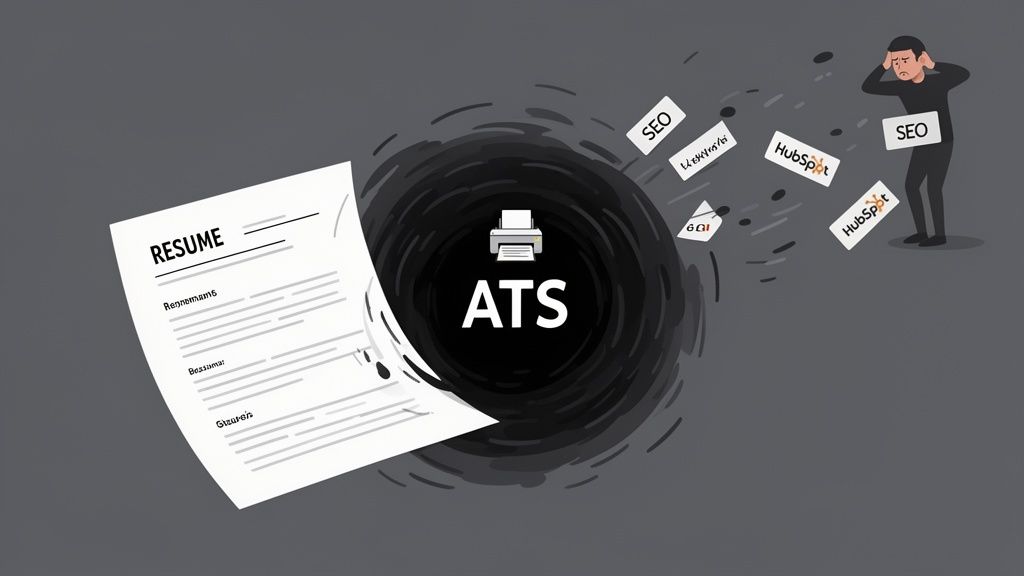
Here's something that took me a while to accept early in my recruiting career: talent alone doesn't get you an interview. You could be the sharpest marketer in the room, but if your resume can't clear an automated filter, nobody will ever know.
The culprit is called an Applicant Tracking System (ATS). Most mid-size and large companies use one, and its job is straightforward: scan incoming resumes for keywords that match the job description, score each one, and filter out the low matches. If the marketing keywords on your resume don't align with what the system is looking for, your application never reaches a human.
It's a blunt system: no keyword match, no interview. And that's worth understanding before you send out another application.
The Robot Reads Your Resume First
Think about the last time you applied for a role you were genuinely excited about and never heard back. There's a good chance no one actually read your resume. The ATS filtered it out before it ever landed on a recruiter's desk.
According to widely cited industry estimates, roughly 75% of resumes are rejected at this stage, which means three out of four applicants never get a human review.
The reason this happens so often is that the vast majority of large employers rely on ATS software for their initial screening. The system isn't evaluating your creativity or your storytelling ability, at least not at this stage. It's running a matching game, looking for specific terms pulled from the job posting.
Here are the kinds of marketing keywords a resume scanner typically looks for:
Hard Skills: "SEO," "PPC," "Content Strategy"
Software: "HubSpot," "Salesforce," "Google Analytics 4"
Metrics: "ROI Analysis," "Customer Acquisition Cost (CAC)"
When these marketing keywords are missing from your resume, the system assigns you a low score and moves on. It doesn't matter how qualified you are on paper if the paper doesn't speak the system's language.
How Bots and Humans Read Your Resume
Something that trips up a lot of job seekers is that your resume actually has two audiences, and they read it in completely different ways. Here's how the ATS compares to a human recruiter when reviewing your application.
Focus Area | Applicant Tracking System (ATS) | Human Recruiter |
|---|---|---|
Primary Goal | Keyword matching and scoring | Assessing experience, impact, and culture fit |
Reading Method | Scans for exact phrases and keywords | Skims for achievements, career story, and results |
Formatting | Prefers simple, clean layouts (no columns) | Appreciates professional design and readability |
Language | Needs precise, literal terms from the job description | Responds to compelling language and action verbs |
Priorities | Hard skills, software proficiency, job titles | Quantified results, leadership, problem-solving skills |
In short, the bot is looking for data points while the human wants to see a compelling career story. Your resume needs to satisfy both, and that balancing act is really what this whole guide is about.
A common trap for marketers: writing a resume designed to impress a person, without first making sure it can get past the software. You have to satisfy the bot before you ever get the chance to wow the human.
If you want to understand the mechanics in more detail, we've written a separate guide on how Applicant Tracking Systems work. The bottom line is that your experience matters, but only once you've translated it into the language the software expects to see.
How to Find the Keywords That Actually Land Interviews
The good news is that the hiring manager has essentially given you the answer key. The job description spells out exactly what they're after. Your task is to reflect that language back at them in a way that's truthful and relevant to your experience.
What you actually need are the specific, exact keywords the employer is using in their job posting. Not close approximations, not synonyms you prefer — the actual words they wrote down.
Start by Dissecting the Job Description
Set aside your assumptions about what the company probably wants. Instead, pay close attention to what they're explicitly asking for. When you read through job descriptions, you'll notice two categories of marketing keywords for your resume keep coming up.
Hard Skills: These are the technical tools. Don't just say "CRM." If they ask for "Salesforce Marketing Cloud," that exact phrase needs to be on your resume. Be specific.
Soft Skills: People often gloss over these, but they're critical. Software now scans for phrases like "stakeholder management," and "cross-functional leadership." "Team player" won't cut it.
The logic here is simple. It’s the same as search engine optimization. The principles that help a blog post rank on Google help your resume rank in an ATS. Learn more about SEO content writing best practices.
Build Your Master Keyword List
Here's a tip that saves a lot of time: don't just look at one job posting. Pull up five or ten listings for the same type of role you're targeting.
Keep a simple spreadsheet and track which terms show up again and again. You'll quickly spot patterns — the same tools, the same skill phrases, the same competencies. Those recurring terms form your master keyword list for your niche.
A good target is around 20 to 30 relevant keywords woven throughout your resume, with 10 to 14 of your strongest ones concentrated in your skills section. That ratio tends to hit the sweet spot between thorough and natural-sounding.
Think of your resume less as a career autobiography and more as a targeted marketing document. The marketing keywords you choose are the foundation that connects your experience to the hiring manager's specific needs.
At its core, this whole exercise is about showing the employer you can solve their problem. If you need a jumping-off point, we've put together a list of top resume keywords that work well across different industries.
Where to Place Keywords on Your Resume for Maximum Impact
Finding the right marketing keywords for your resume is only half the equation. Where you place them matters just as much — think of it like real estate, where some locations carry far more value than others.
Both the ATS and human recruiters tend to focus on certain sections first, so scattering keywords randomly throughout your resume isn't going to cut it. You want to be deliberate about placing your strongest terms in the spots that get the most attention.
Sprinkling terms randomly is a surefire way to get overlooked. You need to be intentional. Place your strongest keywords in high-value areas that scanners and humans check first.
Prime Keyword Locations
Not every section of your resume carries the same weight. Here are the spots where keywords tend to have the most impact, both for the scanning software and for the person who eventually reads your application.
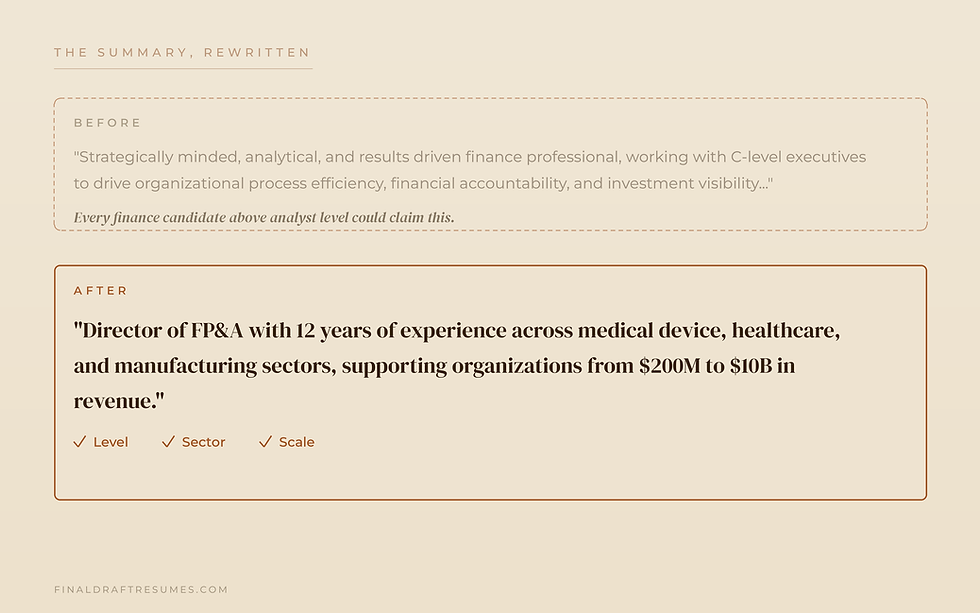
Professional Summary: Weave 2-3 critical keywords here to immediately signal you’re a strong fit.
Core Competencies/Skills Section: Group them logically (e.g., "Digital Analytics," "CRM Platforms") to make it scannable.
Work Experience Bullets: This is where you prove you’ve used the skills. Context is everything.
Focusing on this hierarchy helps you prioritize your efforts when tailoring your resume for each application.
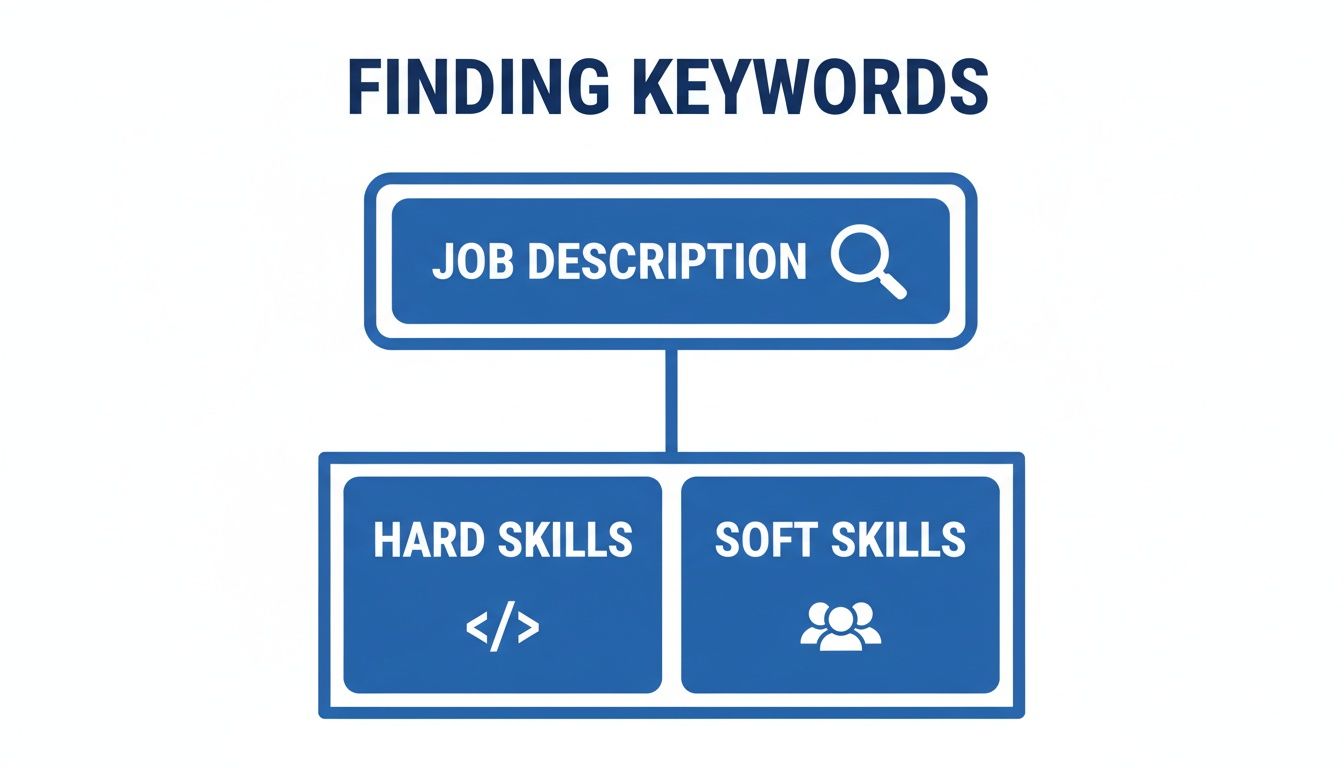
The flowchart above illustrates the basic process: start with the job description, identify the hard and soft skills they mention, and then work those terms into the appropriate sections of your resume. Each keyword should tie directly back to something the employer asked for.
Weave Keywords into Your Achievements
This is something a lot of candidates get wrong: they drop a term like "Data Analysis" into their skills section and call it a day. But a keyword sitting there by itself doesn't tell the recruiter anything about what you've actually accomplished.
The better approach is to weave your keywords into specific, measurable accomplishments. That way, the keyword gets you past the ATS and the achievement impresses the person reading.
Instead of writing "Responsible for content strategy," try this: "Developed a content strategy that boosted organic traffic by 45% in six months by targeting high-intent keywords."
Notice how the second version still contains the keyword "content strategy," which satisfies the ATS, but it also tells a story with a real number attached. That's what makes a recruiter stop and pay attention.
This matters more than you might think. Some industry estimates suggest that modern ATS software rejects a significant percentage of resumes specifically because keywords aren't connected to measurable results.
Of course, keyword placement works best when it's paired with a clean, ATS-friendly layout. If you're unsure about formatting, take a look at our guide on how to properly format an ATS-friendly resume.
How to Beat the Bots Without Sounding Like One
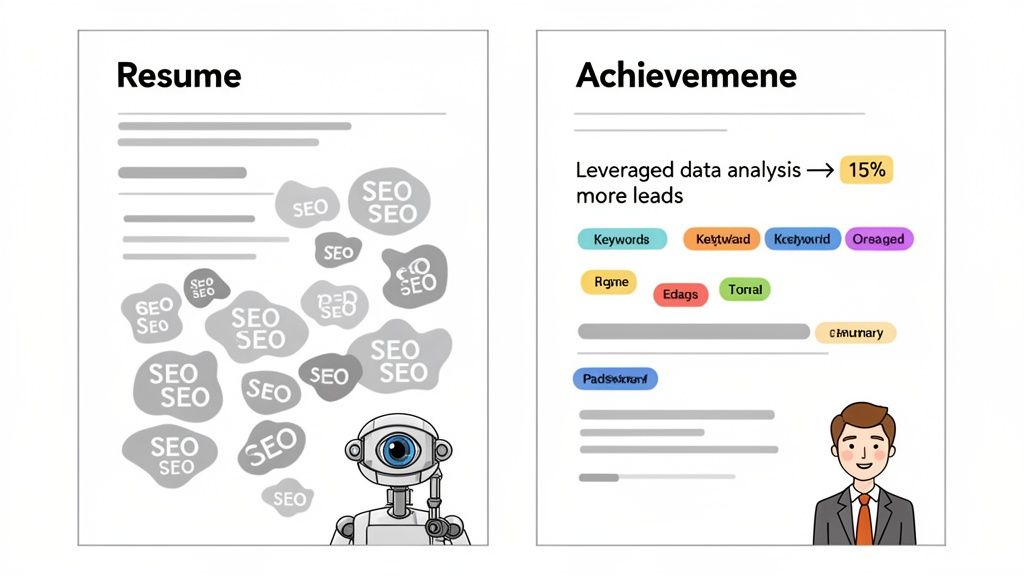
This is where a lot of marketers trip themselves up. They know they need to get past the bot, but they also know a human makes the final hiring decision. So what often happens is they overcorrect in one direction or the other.
Some cram every marketing keyword they can find into their resume until it reads like a glossary. Others write beautifully but ignore the ATS entirely and never get a callback.
The goal is to thread the needle: include enough of the right terms to pass the automated screen, but present them in a way that reads naturally and makes a compelling case for why you're the right hire. You want to sound like a real professional with real accomplishments, not a keyword generator.
From Robotic to Readable
The key is integration. Rather than dumping a list of skills onto the page, work them naturally into bullet points that describe what you've actually done and the results you achieved.
The goal is to demonstrate that you've used the skills, not just that you know the terminology.
There's a real difference between a bullet point that's just a pile of buzzwords and one that tells the story of something you accomplished while naturally weaving in the relevant terms. The latter satisfies the ATS and impresses the hiring manager at the same time.
Let's look at how to transform a robotic bullet point into a compelling, human-friendly achievement.
From Keyword-Stuffed to Human-Readable
Poor Example (Keyword Stuffed) | Great Example (Integrated & Readable) |
|---|---|
Responsible for Go-to-Market (GTM), brand positioning, SEO, content strategy, and marketing automation. | Spearheaded a new Go-to-Market (GTM) strategy that redefined our brand positioning, resulting in a 40% lift in organic search traffic through targeted SEO and a data-driven content strategy. |
See the difference? The great example flows naturally and proves competence. The poor one is just a grocery list of skills. This simple shift gets you from the "maybe" pile to the "must-interview" list.
Your resume is a sales document, not a dictionary. Use keywords to support your achievements, not replace them.
Also, avoid mindless repetition. Use synonyms and related terms. An ATS is smart enough to know "PPC" and "paid search" are related. You don't need to jam the same phrase in every sentence.
Demonstrating both hard and soft skills is critical. Learn how to list soft skills on a resume to truly set yourself apart.
Common Resume Mistakes That Get You Instantly Rejected
Even if you nail your marketing keywords, a resume formatting mistake can undo all that work. I've seen perfectly qualified candidates get filtered out because of something they could have easily avoided.
In my experience reviewing resumes, the same handful of avoidable mistakes come up again and again. Often, candidates invest time in a visually impressive design without realizing that the ATS reads the document very differently than a human eye does. A slick layout can actually work against you.
Fatal Formatting Flaws
Here are some of the most common formatting issues I see that get otherwise strong resumes tossed out before anyone reads them.
Using Headers and Footers: Putting your contact info here is a classic error. Many ATS parsers can't read these sections. Your name and phone number become invisible. Keep all info in the main body.
Submitting the Wrong File Format: Unless they ask for a PDF, a .docx file is often safer. Some older ATS platforms struggle with PDFs, jumbling the text. Always follow instructions to the letter.
Getting Too Creative: Fancy graphics, columns, and logos confuse the ATS. The software reads left-to-right, top-to-bottom. Columns turn your sentences into nonsense. Stick to a clean, single-column layout.
If there's one takeaway from this section, it's this: stop sending the same resume to every job. Tailoring your marketing keywords for each application takes more effort, but it's the single most impactful change you can make.
Getting the formatting right is just as important as choosing the right marketing keywords for your resume. For a deeper look at common pitfalls, take a look at our guide on the biggest resume mistakes and how to fix them.
Answering Your Top Questions About Resume Keywords
Even once you've got a handle on the basics, some of the finer points around resume keywords can trip you up. Here are the questions I get asked most often.
How Many Keywords Are Too Many?
There's definitely a point of diminishing returns. For most applications, somewhere between 20 and 30 well-chosen keywords is the sweet spot. You want enough to cover the important skills and tools, but not so many that your resume starts reading like a keyword dump.
If you find yourself having to force a term into a sentence where it clearly doesn't belong, that's a sign you've gone too far. A good rule of thumb: if it reads naturally out loud, you're in good shape.
Do Keywords Need to Be an Exact Match?
In most cases, yes, and here's why: you don't want to give the software any reason to count you out.
While some newer ATS platforms are sophisticated enough to recognize that "PPC" and "Paid Search" refer to the same thing, plenty of older systems aren't. Since you can't know which software a company uses, matching the exact phrasing from the job description is the safest bet.
If the job description asks for "Go-to-Market (GTM) strategy," use that exact phrase.
Mirroring the exact language from the job description is the safest and most effective way to get past that initial digital gatekeeper. It's a simple step that makes a huge difference.
How Do I Use Keywords for a Career Change?
When you're pivoting, your transferable skills are your best asset. The trick is to frame them using the language of your target industry.
Dig into job descriptions for the career you want. Pinpoint keywords that overlap with your past experience. For instance, a salesperson moving into marketing should highlight:
CRM Management (Salesforce)
Client Relationship Building
Lead Nurturing
Revenue Growth
By framing your existing experience in the vocabulary of your target field, you make it much easier for both the ATS and the recruiter to see how your background translates.
Should Keywords Go in My Cover Letter?
Definitely. Your cover letter gets reviewed by both the ATS and the human reader, so it's another opportunity to reinforce that you're a strong match.
Try to work in three to five of the most important marketing keywords from the job description. It helps with the automated scan and also signals to the person reading that you've done your homework on what the role requires.
Figuring out the right marketing keywords for your resume and navigating ATS software can feel overwhelming, especially when you're juggling a job search on top of everything else. If you'd rather have someone handle it for you, the team at Final Draft Resumes specializes in building keyword-optimized resumes that are designed to get past the bots and into the hands of real recruiters. Learn more and book your consultation today.


Comments