CEO Resume Examples & Writing Guide (2026)

A CEO resume is not a longer version of the resume that got you to VP. It is a fundamentally different document. The audience is different (boards, investors, PE firms, executive recruiters), the expectations are different, and the mistakes that sink them are different too.
Most chief executive officer resumes I review share the same core problem: they read like a job description. Long lists of responsibilities, vague references to "driving growth" and "leading teams," and almost nothing that tells the reader what actually changed because this person was in charge.
After writing 1,200+ resumes across every level of seniority, I can say with confidence that CEO resumes are the ones professionals struggle with most. Not because the content is lacking, but because condensing a career of that scope into two pages requires a different kind of editorial discipline.
This guide walks through what a strong CEO resume looks like, how to structure one, and where most executives go wrong.
CEO Resume Examples
The fastest way to understand what works is to look at real examples. Below are two CEO resume samples written for different contexts: one for a growth-stage executive and one for an enterprise CEO.
Example 1: Growth-Stage CEO

This example works because it leads with outcomes that matter to the people reading it: revenue trajectory, fundraising milestones, and the speed at which the organization scaled. The summary anchors the candidate in the startup and scale-up space without being generic about it. The bullet points in the experience section tie directly to enterprise value creation, which is the language that investors and PE-backed boards care about.
Notice the structure. Two pages, clean formatting, no graphics or sidebars. The sections flow from summary to experience to board involvement to education. Nothing competes for attention.
Example 2: Enterprise CEO
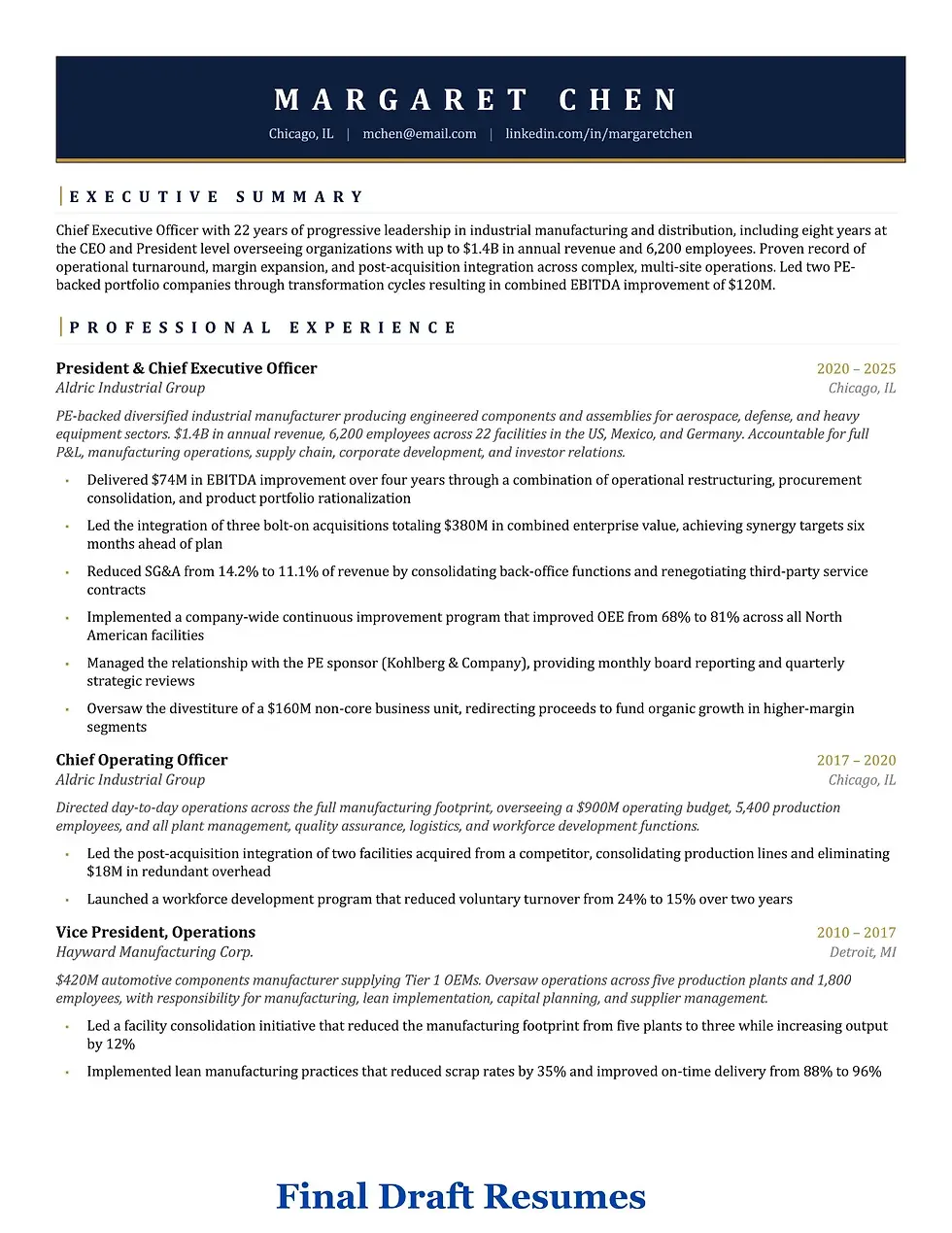
This example takes a different approach because the context demands it. An enterprise CEO is typically communicating stability, margin improvement, and organizational transformation rather than hypergrowth. The summary frames the candidate around P&L scale and operational complexity. The experience bullets focus on restructuring, M&A integration, and margin expansion.
The board memberships and industry affiliations section carries more weight here than in the growth-stage example. At this level, your network and your governance experience are part of the value proposition.
Both examples share a few things in common: they are two pages, they use reverse chronological format, and every bullet point ties to a measurable outcome.
How to Format a CEO Resume
Format decisions at the CEO level are straightforward, but executives overthink them constantly.
Use reverse chronological format. Functional and hybrid formats might work for career changers at other levels, but they create confusion at the executive level. Boards and recruiters expect to see a clean timeline. Any deviation from that raises questions you do not want raised before you are in the room.
Keep it to two pages. Not one, not three. A single page does not give you enough space to communicate the scope of a CEO career. Three pages signals that you cannot prioritize. Two pages is the standard, and there is no strategic reason to deviate from it.
Design should be conservative. No headshot, no icons, no color blocks, no infographics. A CEO resume should look like a serious business document because that is what it is. Clean fonts, clear section headers, consistent formatting, and enough white space that the reader's eye moves easily down the page.
Section order matters. Lead with your summary, follow with professional experience, then include board and advisory roles, education, and relevant affiliations or certifications. If you hold an MBA from a recognizable program, education earns its placement. If not, it still belongs on the resume, just not in a prominent position.
How to Write a CEO Resume Summary
The summary is the first thing anyone reads, and it is where most CEO resumes fall apart.
A strong summary frames your career narrative at a high level. It should answer three questions: What is the scale of what you have led? What industries or domains define your expertise? What is the signature impact you are known for?
That is it. The summary is not the place to restate your bullet points, list soft skills, or describe your management philosophy. It is a positioning statement.
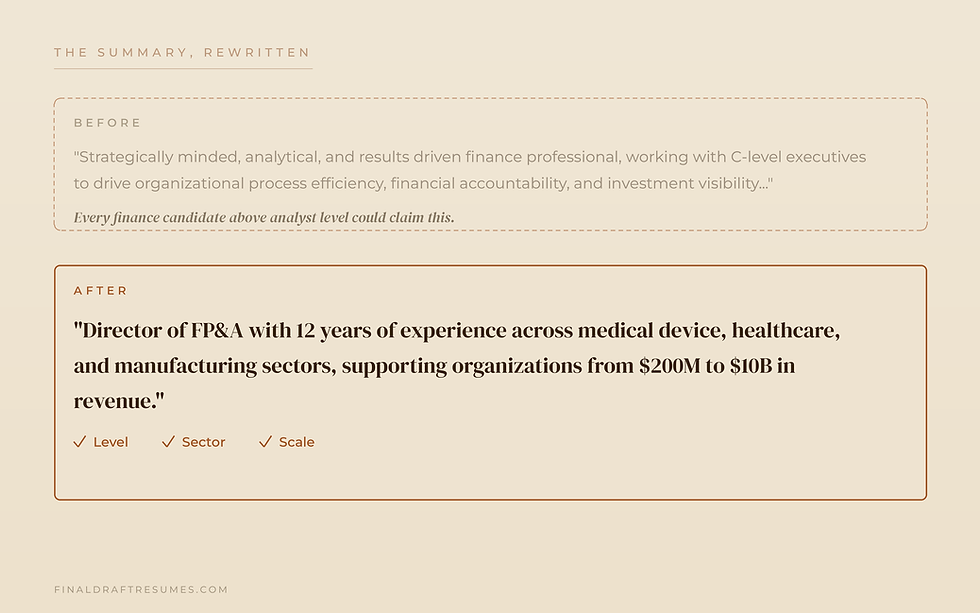
Here is what a weak CEO summary looks like:
"Dynamic and results-oriented executive leader with 20+ years of experience driving growth, building high-performing teams, and delivering innovative solutions across multiple industries."
This could describe anyone. It says nothing specific and gives the reader no reason to keep going.
A stronger version:
"Chief Executive Officer with 18 years of leadership across SaaS and fintech, including two successful exits (combined $340M). Track record of scaling organizations from Series A through acquisition, with direct P&L oversight of up to $120M."
Same person, same career. The difference is specificity. Numbers, context, and a clear throughline that tells the reader exactly what kind of CEO they are looking at.
For more executive summary breakdowns, see our executive resume summary examples.
Writing the Experience Section

Your experience section is where the substance lives. Every bullet should pass a simple test: does it tell the reader what changed because you were in the role?
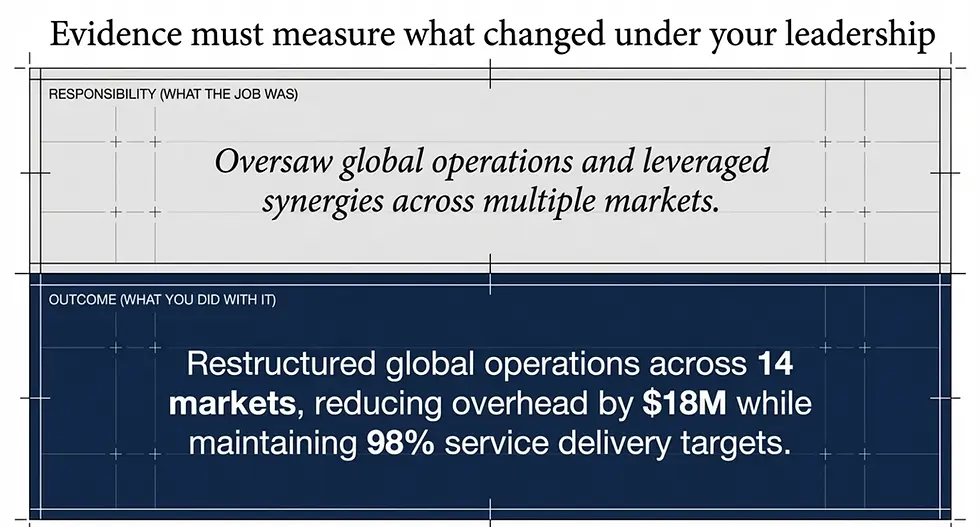
Lead with outcomes, not responsibilities. "Oversaw global operations" is a responsibility. "Restructured global operations across 14 markets, reducing overhead by $18M while maintaining 98% service delivery targets" is an outcome. The first one describes what the job was. The second one describes what you did with it.
Quantify wherever you can. Revenue growth, margin improvement, headcount scaling, market share gains, cost reductions, deal values, fundraising totals. These are the proof points that make a CEO resume credible. If you cannot attach a number to a bullet, ask yourself whether the bullet is earning its space on the page.
Be specific about what you inherited versus what you built. This is a nuance that many executives miss. A board considering you for a CEO role wants to understand your starting conditions. Growing revenue from $5M to $40M tells a different story than growing it from $200M to $240M, even though the percentage looks better on the second one.
Keep your language clean and direct. If a bullet includes the words "synergize," "leverage," or "spearhead," rewrite it. Professional language does not mean corporate jargon. The best CEO resumes read like someone explaining their career to a sharp colleague over coffee, not like a press release.
For roles older than 10 to 15 years, reduce the detail significantly. A brief mention of the company, title, and one or two key accomplishments is enough. The reader cares most about what you have done recently.
Key Sections Most CEOs Miss
Beyond summary and experience, there are sections that separate a strong chief executive officer resume from a forgettable one.
Board memberships and advisory roles. If you sit on boards (corporate, nonprofit, or advisory), these deserve their own section. Board experience signals governance maturity and peer-level credibility.
Speaking engagements and thought leadership. Conference keynotes, published articles, podcast appearances, or panel participation all reinforce your visibility and authority in your industry.
Industry and professional affiliations. Memberships in YPO, WPO, industry associations, or standards bodies show engagement beyond your own organization.
Philanthropic and nonprofit involvement. This is not about padding the resume. Board seats at nonprofits demonstrate leadership range and community investment, both of which matter to the kinds of organizations that hire CEOs.
If you have these credentials and they are not on your resume, you are leaving value on the table.
Common CEO Resume Mistakes
These come up consistently across the CEO resumes I review.
Making it three or four pages. No one reads a four-page resume. If you cannot edit your career down to two pages, that is itself a signal about prioritization.
Including every role going back 25 years. Your first job out of college does not belong on a CEO resume. Anything beyond 15 years should be a brief mention at most, or omitted entirely.
Burying the narrative under dense blocks of text. If your experience section has paragraphs instead of bullet points, or if each bullet runs four lines, you are losing readers. Conciseness is not optional at this level.
Using a creative or heavily designed template. Graphic-heavy templates with skill bars, icons, and sidebars are built for junior professionals. A CEO resume should be visually clean and structurally simple.
Writing in first person. Resumes are written in implied first person. "I led a team of 200" becomes "Led a team of 200." This is a basic convention that still trips up experienced professionals.
Listing soft skills without context. "Leadership" and "strategic vision" mean nothing on their own. If a skill cannot be demonstrated through a specific accomplishment, it should not appear on the resume.
Next Steps
If you have the raw material and the patience, this guide gives you everything you need to write a strong CEO resume on your own. Take your time with it. The summary alone is worth spending a few hours on.
If you would rather hand it off to someone who does this daily, I offer a dedicated Executive resume writing service built specifically for C-suite professionals. The process includes a one-on-one consultation, a full career document strategy, and unlimited revisions.
Either way, the goal is the same: a resume that reflects the actual scope of what you have built and led, not a generic document that undersells it.
Frequently Asked Questions
What does a CEO resume look like?
A CEO resume is a two-page document in reverse chronological format with a clean, conservative design. It opens with a summary that frames your career at a high level, followed by an experience section with quantified accomplishments, board and advisory roles, education, and professional affiliations. There are no graphics, no skill bars, and no headshot.3
How long should a CEO resume be?
Two pages. A single page does not provide enough space to represent the scope of a CEO career, and anything beyond two pages suggests an inability to prioritize. Two pages is the accepted standard among executive recruiters and board-level hiring committees.
Should a CEO use a resume or a CV?
In North America, use a resume. A CV is the standard in Europe, the UK, and academic contexts. If you are applying to roles in multiple regions, it is worth having both versions available. The content is largely the same, but formatting conventions and expected length differ.
What should a CEO put in their resume summary?
Your summary should communicate three things: the scale of organizations you have led (revenue, headcount, geographic scope), the industries or domains that define your expertise, and your signature impact or the results you are most known for. It should not restate bullet points from the experience section or list generic soft skills.


The advice on keeping a CEO resume focused on leadership and measurable results makes a lot of sense. Clear achievements definitely stand out more than a long list of duties. Time for a quick round of space waves after polishing my own resume!