Finance Director Resume: What Gets Interviews at This Level

A finance director resume should lead with the business outcomes you influenced: capital decisions, margin improvement, cash visibility, and the systems your team built, not the reporting cycles you supervised. Recruiters screening director-level finance candidates decide within the first third of page one whether you operate as a business partner or a very senior accountant, and most resumes at this level read like the latter.
Key Takeaway
Open with a one-line scope statement (years, sectors, revenue range) instead of an adjective-heavy summary paragraph.
Write every bullet outcome first and mechanism second, with a real number wherever one exists.
Cut the competency wall. Recruiters and ATS systems both get more signal from company context lines and quantified bullets.
What should a finance director resume lead with?
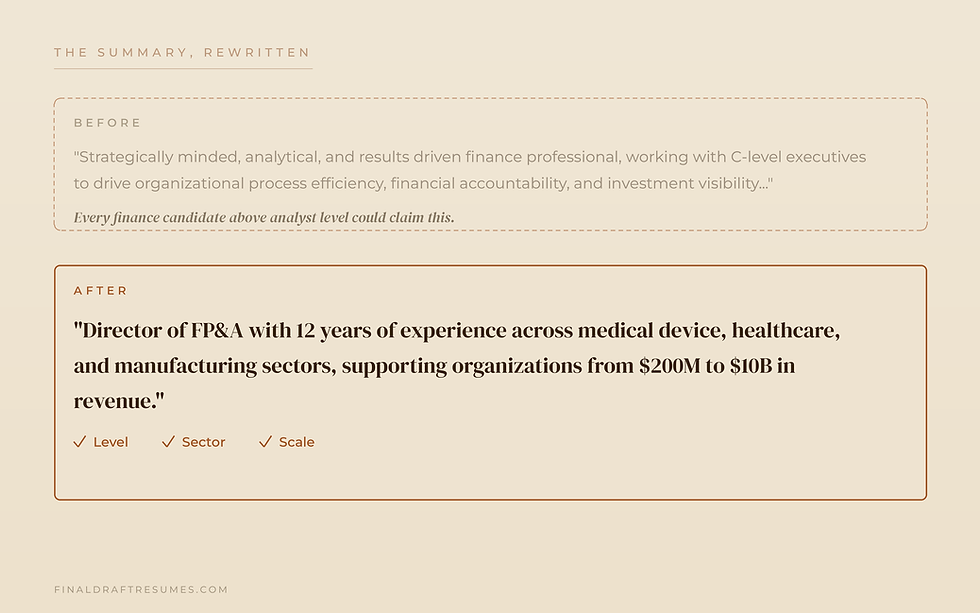
Most finance leadership resumes open with a paragraph that sounds like this: "Strategically minded, analytical, and results driven finance professional, working with C-level executives to drive organizational process efficiency, financial accountability, and investment visibility." I didn't invent that example. It's the actual opening of a resume that landed on my desk from a senior FP&A leader with a genuinely strong record, and it tells a recruiter almost nothing, because every finance candidate above the analyst level could claim the same sentence.
What works at the director level is a scope statement. One or two lines that establish your level, tenure, sectors, and the size of the businesses you've supported. The rewrite for that same client opened with: "Director of FP&A with 12 years of experience across medical device, healthcare, and manufacturing sectors, supporting organizations from $200M to $10B in revenue."
That single line does the filtering work a recruiter needs. It answers level, industry, and scale, which are the three things search firms actually screen on before they read a single bullet. Everything else the adjective paragraph tried to claim (strategic, analytical, influential) gets proven in the experience section instead, where it's believable.

What does a real finance director resume rewrite look like?
Here's the case behind that opening line. The client was a senior FP&A leader in the medical device industry who had grown from an analyst role at a $10B manufacturer into running financial planning for a $200M public company, and was positioning for Director of FP&A roles. The record was there. The resume was hiding it.
The before version had four problems I see constantly on finance resumes at this level. It opened with the adjective paragraph quoted above. It followed that with a "core competencies" wall of sixteen pipe-separated phrases, from Cross-Functional Partnerships to Change Management. The role descriptions ran as dense paragraphs, and the single most impressive number in the entire document, $16M in annual savings from a risk management platform the client's team built, sat at the bottom of the oldest role on page two.
The rewrite made four moves.
First, the scope statement replaced the summary paragraph, and the competency wall came out entirely. Skills that mattered (specific systems like SAP, Hyperion, NetSuite, and Power BI) moved to a short section at the end.
Second, every employer got a one-line context statement. Recruiters outside your industry don't know that a company is a $200M medical device business or a $10B aluminum producer, and that context changes how they read every bullet under it. A candidate managing planning for 12 departments at a $200M public company is a different profile than the same sentence at a $5M private one.
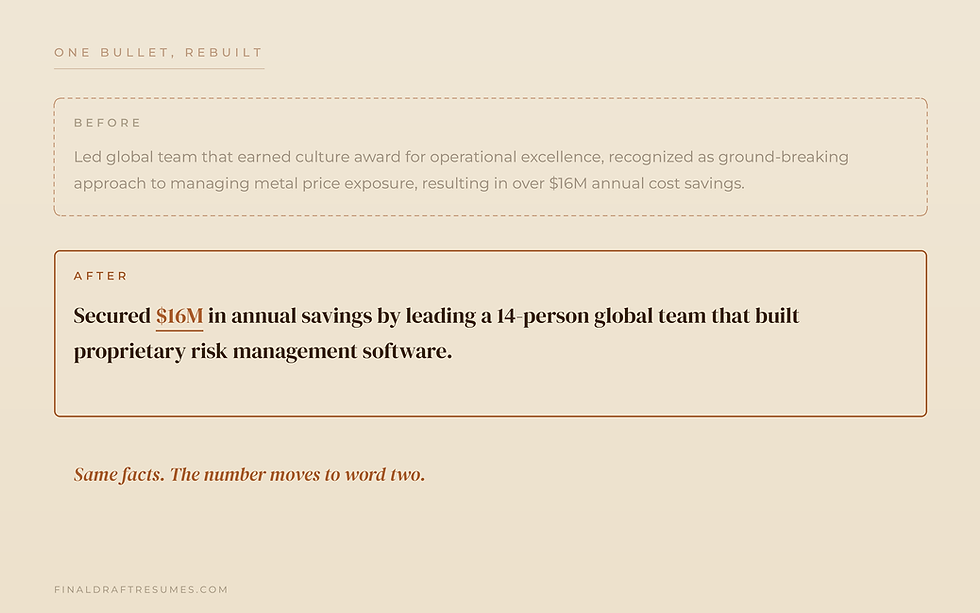
Third, the bullets flipped to outcome-first structure. The before version read: "Led global team that earned culture award for operational excellence, recognized as ground-breaking approach to managing metal price exposure, resulting in over $16M annual cost savings." The award leads and the money arrives at the end, which is backwards. The rewrite: "Secured $16M in annual savings by leading a 14-person global team that built proprietary risk management software." Same facts, but the number a hiring manager cares about is the first thing they read.
The same pattern applied across the document: cash flow projections held within $1M variance per quarter, adjusted EBITDA improved 50% in 12 months, $500K in duplicate software costs eliminated. All of those numbers existed in the client's work. Almost none of them appeared in the before version, because the original bullets described activities and let the results go unstated.
Fourth, the current role split into responsibilities and a "Select Highlights" section, separating run-the-business work (monthly reviews, close oversight, board reporting) from change-the-business achievements (the first company-wide 5-year plan, a new project coding system, the EBITDA initiatives). Director-level hiring committees care about the second category, and mixing the two buries it.
Which achievements matter most on a finance director resume?
When I'm rebuilding a finance leadership resume, these are the categories I go hunting for in the client's history, roughly in order of how hard they work on the page:

P&L and budget scope, with a number. "Led planning and oversight of operating and capital budgets for 12 departments" means little until the reader knows it's a $200M operation with a $20M capital budget. State the scale every time.
Cash and working capital outcomes. Forecast accuracy, cash burn visibility, working capital efficiency gains. Finance directors at growth-stage and PE-backed companies get hired for cash discipline before anything else.
Margin and EBITDA movement. Any initiative you led or materially supported that moved gross margin, operating margin, or EBITDA belongs high on page one, with the percentage and the timeframe.
Systems and model transformation. A three-statement model built from scratch, an ERP implementation, a Power BI reporting layer that other markets adopted. These prove you build infrastructure rather than just operate it.
Board and executive exposure. Producing board materials, presenting to the CFO and senior leadership, supporting earnings calls or SEC filings. Say it plainly; committees want directors who've already been in those rooms.
Team leadership with real numbers. How many people, what functions, what geographies. "Led 11 consultants through a Medicare bid representing $500M in revenue" beats any sentence containing the word "leadership."
Controls and audit record. SOX implementation, zero audit findings, clean compliance across a growth phase. Unglamorous, and exactly what audit committees and CFOs screen for.
Capital allocation and investment analysis. NPV models, ROI evaluation, pricing strategy, M&A or expansion support. This is the clearest evidence that you think like a business owner rather than a scorekeeper.
Cost reduction with verified figures. Real dollar amounts from real initiatives. A single specific number ($500K in duplicate software costs) is worth more than any claim about "identifying efficiencies."
Cross-functional partnership with named functions. Not "collaborated with stakeholders." Name them: R&D, Sales, IT, HR, actuarial teams. Specificity is what separates genuine business partnership from resume language about it.
If your draft has fewer than five of these categories represented with numbers, the problem usually isn't your career. It's that your bullets describe what you were responsible for instead of what happened because you were there.
When shouldn't a finance director resume chase the CFO framing?
There's a strain of advice that tells every finance director to write their resume "like a future CFO," and for a meaningful share of candidates it backfires. If you're targeting a director seat at a larger company, a resume styled as a CFO-in-waiting at a $200M business can read as either overreach or flight risk, and hiring managers screen for both. The stronger play for most director candidates is depth at the director level: bigger scope, more complex businesses, harder problems, not a costume fitting for a title two levels up.
The related question is what to do when your title lags your work. The client in the case above held a Senior Manager title while operating at director scope, which is common, because titles compress and expand with company size. The answer isn't to inflate the job title in your work history; that fails background checks and burns trust. It's to let the positioning line and the scope evidence carry the argument. A headline of "Director of FP&A" over a history that shows 12-department planning ownership, board reporting, and a $20M capital budget is a defensible functional claim. The same headline over bullets about running reports is not.
What do recruiters actually screen for in finance leadership resumes?
Having watched this from the r/resumes side and from hundreds of client searches, the screen at this level is narrower than candidates assume. Recruiters are matching revenue scale (have you supported a business the size of ours), sector familiarity (medical device, healthcare, and manufacturing experience gets read differently at a SaaS company), systems (the ERP and planning stack you've lived in), and trajectory (promotions and expanding scope, which is why the case client's move from analyst to senior manager across three employers mattered enough to keep visible rather than compress).
What they're not doing is reading your competency list or admiring your summary adjectives. Every element on the page either helps them match you to a spec in under a minute or it's taking up room that something quantified could use.
Frequently asked questions
Q: How long should a finance director resume be?
A: Two pages for almost everyone at this level. One page forces you to cut the scope evidence that justifies a director title, and three pages signals you can't prioritize. Compress roles older than 12 to 15 years into an early career section with titles and employers only, and spend the recovered space on your two most recent positions.
Q: Should a finance director resume have a summary section?
A: Yes, but keep it to one or two lines of scope: your level, years of experience, sectors, and the revenue range of the companies you've supported. Skip the adjective paragraph entirely. Words like strategic, analytical, and results-driven claim qualities the reader will only believe once your bullets demonstrate them, so let the bullets do that work.
Q: How do I write a finance director resume if my current title is senior manager?
A: Position by function and scope rather than inflating the title. Keep your real titles in the work history, use a functional headline like "Director of FP&A" only if your evidence supports it, and make the scope explicit: departments covered, budget size, board exposure, team leadership. Titles vary widely by company size, and experienced recruiters read scope before they read titles.
Q: What skills should a finance director resume include?
A: A short, specific systems list: your ERP (SAP, Oracle, NetSuite), planning tools (Hyperion, Adaptive), and analytics stack (Power BI, SQL, advanced Excel modeling). Cut soft-skill lists completely. Leadership, communication, and strategic thinking are proven through quantified bullets about teams, presentations, and decisions, and a keyword wall of them actively weakens the page.
Q: Do finance director resumes need special formatting for ATS?
A: They need clean, standard formatting, which is a lower bar than the ATS industry suggests. Use standard section headings, avoid tables and text boxes for critical content, and include the terminology from the posting naturally in your bullets. A well-written finance resume with real keywords in context passes parsing without any special tricks.
About the author
Alex Khamis, CPRW, is the founder of Final Draft Resumes and a moderator of r/resumes (1.2M+ members). He's personally written resumes for over 1,200 professionals since 2019, with a particular focus on finance and operations leadership. LinkedIn | Full bio
If you're a finance leader preparing a move and want a credentialed second pair of eyes on your resume, you can book a discovery call. It's a 30-minute conversation, no pressure, and I'll tell you up front whether you actually need a writer or whether the resume you have is closer than you think.


Comments